Before entering an unfamiliar promotion, one of the smartest questions you can ask is: who is actually running it? Knowing how to verify a giveaway organizer can help you distinguish a legitimate sponsor or promotion administrator from an impersonator, misleading website, or prize scam.
A giveaway may feature a well-known product without being organized by the company that manufactured that product. It may also be operated by a marketing agency, retailer, publisher, promotion administrator, or another organization acting on behalf of the sponsor.
That means recognizing the prize brand is not enough. You should be able to identify the organization responsible for the promotion and confirm that its connection to the giveaway makes sense.
This guide explains how to verify a giveaway organizer using 10 practical checks before you enter or respond to a winner notification.
How to Verify a Giveaway Organizer
Verifying a giveaway organizer means confirming that the organization named in the promotion actually exists, has a credible connection to the giveaway, and can be independently linked to the official rules, website, contact information, or promotion administrator.
A useful verification process includes checking:
- The sponsor named in the official rules.
- The official website and domain.
- Independent contact information.
- The promotion administrator.
- Official social media accounts.
- The privacy policy.
- The organization’s public online presence.
- The consistency of the giveaway details.
- The winner-notification process.
- Any requests for money or sensitive information.
No single check guarantees that a promotion is legitimate. The strongest verification comes from several pieces of information that consistently point to the same organizer.
1. Identify the Sponsor Named in the Official Rules
Start with the official rules whenever they are available.
Look for wording such as:
- Sponsored by.
- Sponsor.
- Promotion sponsor.
- Administrator.
- Promotion administrator.
The rules may identify a legal company name that is different from the consumer-facing brand you recognize.
For example, a company may market products under one brand while its official legal entity uses another corporate name.
That difference is not automatically suspicious.
Prize Brand Does Not Always Mean Giveaway Organizer
This distinction is particularly important.
Suppose a travel company gives away a smartphone. The phone manufacturer may have no involvement in the promotion at all.
Likewise, a retailer may give away products from several well-known brands without those brands acting as sponsors.
Always identify the organization named as the sponsor rather than assuming that the brand printed on the prize is the organizer.
Our guide to official sweepstakes rules explains where sponsor and administrator information commonly appears.
2. Verify the Organizer’s Official Website Independently
Once you know the organizer’s name, find its official website independently.
Do not rely entirely on a URL received through:
- An unexpected email.
- A direct message.
- A text message.
- A winner comment.
- An unfamiliar advertisement.
Instead, search for the organization yourself or navigate to a website you already know belongs to it.
Compare the Domain Carefully
Impersonator websites can use domain names that resemble legitimate ones.
Look for subtle differences such as:
- Extra letters.
- Missing letters.
- Unexpected hyphens.
- Different domain extensions.
- Additional words before or after the brand name.
- Misspellings that are easy to overlook.
A familiar logo on an unfamiliar domain is not enough to establish authenticity.
HTTPS Alone Does Not Prove a Giveaway Is Legitimate
A secure HTTPS connection is useful for protecting data in transit, but scammers can also obtain security certificates for websites.
Therefore, the padlock or HTTPS indicator should not be treated as proof that the organization itself is trustworthy.
Verify the domain, organization, and promotion together.
3. Confirm Contact Information From an Independent Source
A giveaway page may provide an email address or telephone number, but you should not always use those details as your only verification source.
If you are unsure about a promotion, find the company’s contact information independently through its established official website.
Then compare it with the giveaway.
Look for consistency in:
- Company name.
- Website domain.
- Customer-support information.
- Business address where relevant.
- Official email domains.
Why Independent Contact Verification Matters
A scammer can create a fake giveaway page and then provide a fake support email address on that same page.
Contacting that address only sends you back to the scammer.
Independent verification breaks that loop.
The Federal Trade Commission recommends finding the real company’s contact information yourself when you are unsure about a prize claim rather than relying on information supplied by the person contacting you.
For additional guidance, see the FTC guidance on fake prize and sweepstakes scams.
4. Understand the Difference Between Sponsor and Administrator
The organization sponsoring a giveaway may not be the company handling its day-to-day administration.
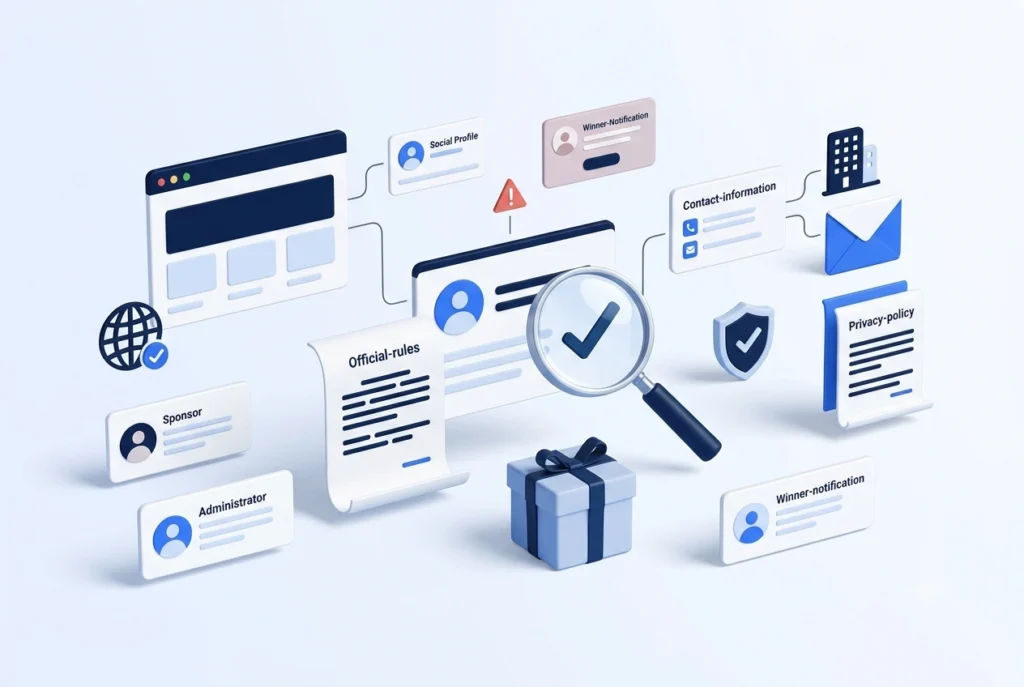
A promotion can involve several parties, including:
- Sponsor: the organization responsible for sponsoring the promotion.
- Administrator: a company that manages some or all of the promotion process.
- Prize provider: an organization supplying a prize.
- Retailer: a business participating in distribution or promotion.
- Marketing agency: a company managing campaign activities.
- Fulfillment provider: a company helping deliver prizes.
This means receiving a legitimate email from a company other than the sponsor is possible.
How Do You Verify a Promotion Administrator?
Start with the official rules.
If the rules identify an administrator by name, search for that company independently and see whether its business activity is consistent with promotion administration.
You can also check whether:
- The administrator’s domain matches winner communications.
- The sponsor’s rules explicitly name the administrator.
- The administrator has an established professional website.
- The contact process is consistent across the promotion.
A third-party administrator should have a verifiable connection to the sponsor rather than appearing unexpectedly with no explanation.
5. Cross-Check Official Social Media Accounts
If a giveaway is promoted through social media, verify that the account has a genuine connection to the organization.
One useful method is cross-checking the social profile through the company’s official website.
For example, if the company’s website links to its established social profile, that connection is stronger than simply searching the platform for a familiar logo.
Watch for Nearly Identical Accounts
Impersonators may copy:
- Profile pictures.
- Brand graphics.
- Biographies.
- Recent posts.
- Giveaway images.
and then use a slightly altered username.
Pay attention to:
- Spelling.
- Extra numbers.
- Underscores.
- Punctuation.
- Account history.
- Links in the profile.
The FTC has warned that scammers may exploit legitimate social media giveaways by impersonating the real business and contacting entrants for personal or financial information.
For a full social-specific checklist, read Are Social Media Giveaways Safe? 12 Safety Tips.
6. Review the Privacy Policy Before Sharing Personal Information
A legitimate giveaway often needs some personal information to administer entries.
Depending on the promotion, that might include:
- Name.
- Email address.
- Country.
- Age confirmation.
- Postal code.
- Other information relevant to eligibility.
Before providing information, look for a privacy policy or privacy notice explaining who is collecting the data and how it may be used.
Check Whether the Privacy Policy Matches the Organizer
A useful privacy notice should help you identify the organization responsible for the information.
Look for:
- The company name.
- The website or domain.
- Types of data collected.
- Reasons for collection.
- Information-sharing practices.
- Contact or privacy-request information.
Be cautious if a giveaway collects extensive personal information while providing no clear explanation of who is receiving it.
For email-specific privacy issues, see Why Giveaways Ask for Your Email.
7. Research the Organizer’s Public Reputation
If the organizer is unfamiliar, research the name before entering.
The FTC recommends searching for a contest or company name together with words such as “review,” “complaint,” or “scam” when you are uncertain about a prize promotion.
You can search for combinations such as:
- Company name + reviews.
- Company name + complaints.
- Company name + scam.
- Company name + giveaway.
- Company name + sweepstakes.
Do Not Treat One Negative Comment as Definitive Proof
Online reviews require judgment.
A legitimate business can receive negative reviews, and scammers can also create false positive reviews.
Instead of relying on a single comment, look for broader patterns.
Questions to consider include:
- Does the organization have an established online history?
- Are there repeated reports describing the same suspicious behavior?
- Does the company’s website appear consistent with its stated business?
- Are independent references to the company available?
- Does its giveaway history appear credible?
What About a New Company?
A recently launched company is not automatically fraudulent.
New businesses and creators can run legitimate giveaways.
However, when the organizer has very little history, you may need to rely more heavily on the quality and consistency of the official rules, domain, contact information, privacy details, and promotion structure.
8. Check Whether the Giveaway Details Are Consistent
A legitimate organizer should generally present promotion details that make sense together.
Compare information across:
- The giveaway page.
- The official rules.
- Social media posts.
- The organizer’s website.
- Entry forms.
- Winner communications.
Look for consistency in:
- Prize description.
- Closing date.
- Eligible countries.
- Minimum age.
- Entry method.
- Number of winners.
- Organizer name.
- Winner-selection procedure.
Major Contradictions Deserve Investigation
For example, suppose:
- The social post says the prize is $500.
- The entry page says $5,000.
- The official rules mention a completely different prize.
That inconsistency does not automatically prove fraud, because mistakes can occur, but you should clarify the discrepancy before providing information.
Check the Eligibility Information Too
A promotion advertised globally can still be restricted geographically.
Confirm age, country, residency, and other requirements through the rules rather than relying only on promotional graphics.
See our Giveaway Eligibility Requirements guide for a complete checklist.
9. Verify How Winners Are Supposed to Be Contacted
Organizer verification becomes especially important when someone tells you that you won.
Return to the official rules and determine whether winners are expected to be contacted by:
- Email.
- Telephone.
- Text message.
- Social media direct message.
- Postal mail.
- An account notification.
- Another specified method.
If the original rules say winners are contacted by email but an unrelated social profile suddenly tells you to send money through a direct message, the discrepancy should immediately trigger additional verification.
Verify the Sender, Not Just the Message
A professional-looking message can still be fake.
Check:
- The actual sender address.
- The email domain.
- The social username.
- The administrator named in the rules.
- The timing of the notification.
The FTC warns that scammers may impersonate recognizable sweepstakes companies or well-known organizations when sending fraudulent prize notifications.
For more detail, see How Giveaway Winners Are Contacted: 10 Things to Expect.
10. Never Let a Prize Claim Prevent Independent Verification
A legitimate giveaway organizer should not need to prevent you from checking who they are.
Be especially suspicious when someone:
- Demands immediate payment.
- Tells you not to contact the real company.
- Creates extreme urgency.
- Refuses to provide official rules.
- Uses only an unverifiable messaging account.
- Asks you to keep the prize secret.
- Demands banking credentials merely to release the prize.
- Requests gift cards or cryptocurrency.
The FTC states that legitimate sweepstakes prizes are free and warns that requests for processing fees, shipping charges, customs duties, or similar payments to receive a supposed prize are signs of a scam.
Use Contact Information You Find Yourself
If someone claims to represent a known organization:
- Stop communicating temporarily.
- Find the company’s official website independently.
- Use contact details from that verified source.
- Ask whether the promotion and communication are legitimate.
Do not use only the phone number or email address supplied by the person whose identity you are trying to verify.
Sponsor vs Brand vs Administrator: What Is the Difference?
These terms are easy to confuse.
Sponsor
The sponsor is the organization identified as sponsoring the giveaway and is commonly named in the official rules.
Brand
A brand may appear because:
- It is the sponsor.
- Its product is being awarded.
- It partners with the organizer.
- The organizer sells its products.
- It has another promotional connection.
Do not automatically treat every prize brand as a sponsor.
Administrator
The administrator may manage the promotion on behalf of the sponsor, including entry processing, drawing administration, winner communication, or fulfillment.
Prize Provider
A prize provider may supply a product or service without being responsible for operating the promotion itself.
Does a Famous Brand Name Prove the Organizer Is Legitimate?
No.
Scammers can copy the names and branding of established businesses.
The FTC specifically warns that prize scammers may pretend to represent organizations people recognize in order to appear credible.
Therefore, do not verify an organizer based only on:
- A logo.
- Product photo.
- Company name in a username.
- Familiar-looking email design.
- A copied website header.
Verify the connection through the company’s genuine website, rules, and independent contact channels.
Does an Official-Looking Website Prove a Giveaway Is Legitimate?
No single design feature can prove legitimacy.
A sophisticated website can be copied or created quickly.
Instead, examine the complete picture:
- Domain.
- Company identity.
- Official rules.
- Contact details.
- Privacy policy.
- Public history.
- External references.
- Winner process.
A legitimate-looking design should support other verification evidence, not replace it.
Should a Giveaway Organizer Provide Official Rules?
Clear official rules or promotion terms are an important source of information for entrants.
They can identify:
- The sponsor.
- The administrator.
- Eligibility.
- Entry dates.
- Entry limits.
- Prizes.
- Winner selection.
- Winner notification.
- Other promotion conditions.
A small informal promotion may not present its terms in exactly the same format as a large corporate sweepstakes, but a lack of basic information becomes more concerning as the prize value, complexity, or amount of requested personal information increases.
Can a Legitimate Giveaway Use a Third-Party Website?
Yes.
A sponsor does not have to host every giveaway directly on its primary corporate domain.
Legitimate promotions can use:
- Promotion platforms.
- Marketing agency websites.
- Administrator domains.
- Campaign landing pages.
- Retail partners.
The important point is that you should be able to establish a credible connection between the third-party website and the real sponsor.
Official rules are particularly useful for confirming that relationship.
Is Domain Age a Reliable Way to Verify a Giveaway?
Domain age can provide context, but it should not be used as a standalone legitimacy test.
A new domain can belong to a genuine new campaign, startup, or promotion platform.
Likewise, an older domain does not guarantee that every page or offer associated with it is trustworthy.
Use domain information as one piece of a larger verification process rather than a final verdict.
What If You Cannot Find Information About the Organizer?
The absence of search results does not automatically prove fraud, particularly for a small or new organization.
However, the less independently verifiable information you can find, the more cautious you should be about sharing personal or financial information.
Ask:
- Can I identify the sponsor?
- Can I find the official rules?
- Can I verify a real website?
- Can I find independent contact information?
- Does the privacy policy identify the organization?
- Does the prize make sense for this organizer?
- Can I verify the promotion through another official channel?
If almost none of these questions can be answered, consider avoiding the promotion until more reliable information is available.
How to Verify an Organizer After You Receive a Winner Message
Winner verification deserves a second check even when you researched the giveaway before entering.
Use this sequence:
- Find the original giveaway you entered.
- Open its official rules.
- Confirm the sponsor and administrator.
- Check the expected winner-notification method.
- Compare the sender’s email domain or account.
- Verify the timing against the drawing schedule.
- Contact the organizer independently if anything is unclear.
- Do not pay to release the prize.
A real giveaway can still attract fake winner messages from impersonators, particularly on social media.
10-Point Giveaway Organizer Verification Checklist
Before trusting an unfamiliar giveaway organizer, complete these 10 checks:
- Sponsor: Can you identify the organization named in the official rules?
- Website: Can you independently find and verify its official website?
- Contact: Can you confirm contact details without relying entirely on the giveaway message?
- Administrator: If a third party runs the promotion, is that relationship documented?
- Social accounts: Do the giveaway profiles connect with genuine official accounts?
- Privacy: Does the privacy notice identify who collects your information?
- Reputation: Does independent research reveal a credible organization rather than repeated scam reports?
- Consistency: Do the prize, dates, eligibility, and entry method agree across sources?
- Winner contact: Does the notification process match the official rules?
- Payment: Is the organizer avoiding suspicious demands for money or financial credentials to release a prize?
You do not need every organization to be famous. You need enough consistent evidence to establish who is behind the promotion.
Common Giveaway Organizer Verification Mistakes
Avoid these common mistakes:
- Assuming the prize manufacturer is the organizer.
- Trusting a logo without verifying the account or domain.
- Using contact information supplied only by the person claiming you won.
- Assuming every third-party administrator is suspicious.
- Ignoring the sponsor named in the official rules.
- Trusting HTTPS as proof of legitimacy.
- Relying on one positive or negative review.
- Ignoring inconsistencies between the rules and promotional post.
- Assuming a familiar company name in an email proves the sender works there.
- Sending money before independently verifying a prize claim.
Frequently Asked Questions
How do I verify a giveaway organizer?
Start by identifying the sponsor in the official rules, independently finding its official website, confirming contact details, checking any named promotion administrator, and comparing the organizer’s website, social accounts, privacy policy, and winner-notification process.
How can I check if a giveaway company is legitimate?
Research the company’s official website, contact information, rules, public history, and independent reviews. Search the company name with terms such as “review,” “complaint,” or “scam,” while remembering that individual online comments are not definitive proof.
Is the brand giving away the prize always the organizer?
No. A retailer, publisher, partner, marketing company, or another organization may give away a branded product without the product manufacturer being the promotion sponsor.
What is a giveaway sponsor?
The sponsor is the organization identified as sponsoring the promotion. The sponsor is commonly named in the official rules and may use another company to administer the giveaway.
What is a giveaway administrator?
A promotion administrator is a third party that may manage activities such as entry processing, drawings, winner notification, verification, or prize fulfillment on behalf of the sponsor.
Is a third-party giveaway website suspicious?
Not automatically. Legitimate sponsors often use promotion platforms, agencies, and campaign landing pages. Verify that the third party has a credible connection to the sponsor.
Does HTTPS mean a giveaway site is safe?
No. HTTPS protects the connection between your browser and the website, but it does not prove that the person or organization operating the website is legitimate.
Can scammers impersonate legitimate giveaway organizers?
Yes. Scammers may copy company names, logos, websites, social profiles, or promotion posts. Verify the organizer through independent official channels rather than relying only on branding.
Should I contact the organizer if a winner message looks suspicious?
Yes, when appropriate. Use contact information that you independently obtain from the verified official website rather than relying only on information provided in the suspicious message.
Should a giveaway organizer ask me to pay before receiving a prize?
An unexpected demand to pay processing, shipping, customs, tax, or other fees merely to release a supposed sweepstakes prize is a major scam warning sign. Verify the organizer independently and do not send money simply because someone says you won.
Final Takeaway
Learning how to verify a giveaway organizer is one of the most useful safety habits for anyone who regularly enters online promotions.
Start with the official rules and identify the sponsor. Then independently confirm the organization’s website, contact information, promotion administrator, social profiles, and privacy policy.
Do not assume that the company whose product appears as the prize is necessarily running the giveaway, and do not automatically distrust a third-party administrator when the official rules clearly establish its role.
Most importantly, perform verification again if you receive a winner notification. Scammers can impersonate legitimate companies and promotions even when the original giveaway itself is real.
A trustworthy verification process should lead back to several consistent sources rather than one message, account, or website controlled by the person asking for your trust.
Continue with our guides to how to spot a fake giveaway, social media giveaway safety, official sweepstakes rules, and how giveaway winners are contacted.