A fake giveaway is designed to create excitement or urgency so that someone can steal money, personal information or access to an online account. Scammers may imitate recognizable brands, influencers, retailers or sweepstakes companies to make a false prize notification appear trustworthy.
Not every poorly designed promotion is fraudulent, and rules differ between countries and types of competitions. However, several warning signs should make you stop and independently verify the offer before clicking links, submitting information or sending money.
Quick checklist: signs of a fake giveaway
- You are told that you won a giveaway you do not remember entering.
- You must pay a fee, tax or shipping charge to receive the prize.
- The sender pressures you to respond immediately.
- The message comes from an unofficial or misspelled account.
- You are asked for banking, card or account login information.
- Payment is requested through gift cards, cryptocurrency or a wire transfer.
- The official rules, eligibility details or sponsor information are missing.
- The link leads to an unrelated or suspicious web address.
One warning sign may justify further checking. Several warning signs appearing together are a strong reason to stop interacting with the sender.
1. You do not remember entering the giveaway
Start with a simple question: did you actually enter this promotion? Unexpected calls, emails or social media messages claiming that you won an unfamiliar prize deserve immediate caution.
A legitimate winner notification should normally identify the promotion, sponsor and entry connected to the prize. A vague message that says only “you won” may be designed to make you react before thinking.
Do not rely on information supplied by the sender. Search for the promotion independently and compare its official rules, dates and winner-notification process.
2. You must pay to receive the prize
A demand for money is one of the clearest signs of a prize scam. The sender may describe the payment as a processing fee, release charge, insurance payment, shipping cost, customs duty or advance tax.
The U.S. Federal Trade Commission advises consumers that legitimate prizes are free and that someone demanding payment to release a prize is attempting a scam. Laws and tax procedures vary by location, but a supposed organizer should not require secret or unusual payments before identifying the promotion and providing verifiable documentation.
Never send money simply because a message says that payment is required to prevent the prize from being cancelled.
3. The sender creates artificial urgency
Scammers frequently use deadlines such as “respond in ten minutes,” “claim immediately” or “your prize will be given to someone else.” The goal is to prevent you from checking the account, website or official rules.
Slow down. A real organizer should allow a reasonable verification process and should not object when you contact the company through its publicly listed website or support channel.
Urgency alone does not prove fraud because legitimate promotions may have claim deadlines. The important difference is whether the deadline and claim process are documented in accessible official rules.
4. The account does not match the official brand
Fake social media profiles can copy a brand’s name, logo and recent posts. Examine the complete username rather than the display name. Look for extra characters, substituted letters, unusual punctuation and recently created accounts.
A verification badge can be helpful, but it should not be your only check. Visit the brand’s official website manually and follow its social links to locate the genuine account.
Do not assume that an account is legitimate because it has followers, comments or professional graphics. These signals can be copied, purchased or manipulated.
5. The web address is suspicious
Before opening a link, inspect the domain carefully. Fraudulent pages may use misspellings, added words, unfamiliar domain extensions or subdomains designed to resemble an official address.
For example, seeing a brand name somewhere in a long URL does not mean the page belongs to that brand. The registered domain is the important part.
If you want to verify an offer, type the known official website address into your browser or find it through a trusted search result. Do not use the contact details or login link contained in an unexpected winner message.
6. The sender requests financial information
You should not need to provide a bank password, complete payment-card number or online banking login to receive a giveaway prize. Requests for this information may be attempts to steal money or take control of an account.
Some legitimate organizers may need limited information to deliver a prize or complete legally required paperwork. That request should occur through a verifiable process described in the official rules, not through an unexpected direct message.
When uncertain, contact the sponsor using contact information you found independently.
7. Payment must use gift cards or cryptocurrency
Be extremely cautious when someone claiming to represent a giveaway demands payment through gift cards, cryptocurrency, wire transfer or a payment application. These methods can be difficult to reverse and are frequently requested by impersonation scammers.
The sender may instruct you to purchase a gift card and send its code or photograph. Once the code is shared, the funds may be taken quickly. Do not send the code, receipt or card details.
8. There are no accessible official rules
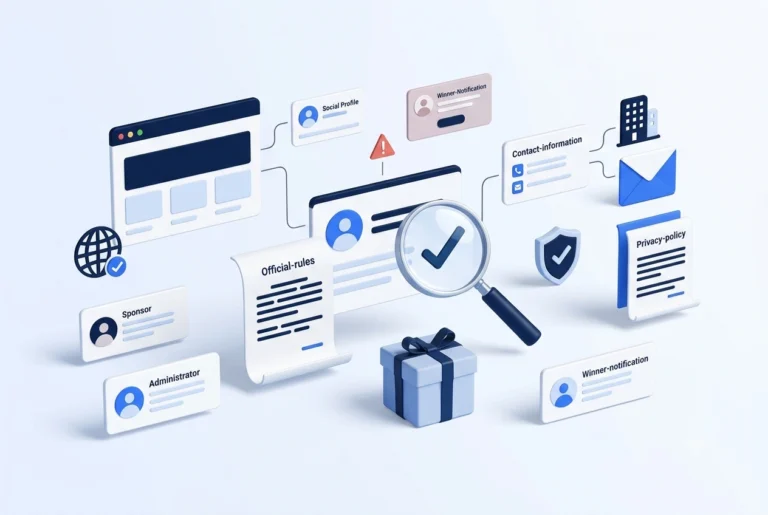
A credible giveaway should provide enough information for participants to understand how it works. Depending on the jurisdiction and promotion, the rules may identify:
- The legal sponsor or organizer.
- Who is eligible to participate.
- The opening and closing dates.
- How entries are submitted.
- The prize and any relevant limitations.
- How winners are selected and contacted.
- Claim deadlines and verification requirements.
Missing rules do not automatically prove that an informal promotion is fraudulent, but they make the offer harder to verify. Avoid providing sensitive information when the organizer, eligibility and prize process remain unclear.
9. The prize description keeps changing
Be cautious if the sender changes the prize, adds unexpected charges or introduces new conditions after you respond. A common tactic is to promise a large reward and then continue requesting smaller payments for invented obstacles.
Compare every claim with the original promotion and its rules. If the details cannot be confirmed through the official sponsor, stop communicating.
10. You are asked to keep the prize secret
A scammer may tell you not to discuss the prize with family, friends, a bank or law enforcement. This isolation prevents other people from questioning the story.
A legitimate organizer should not stop you from seeking advice or independently verifying its identity. Before sending money or sensitive information, speak with someone you trust.
11. The message contains unexpected attachments or login pages
A false winner notification may contain an attachment or link that installs malware or leads to a phishing page. The page may imitate a social network, email provider or retailer and ask you to sign in again.
The FTC recommends avoiding links and attachments in unexpected messages. If the message might be genuine, access the company through a website or application you already trust instead of using the supplied link.
Protect important accounts with unique passwords and multi-factor authentication. Never provide a one-time security code to someone contacting you about a prize.
12. The organizer cannot be independently verified
Search for the organization’s legal name, official website and established contact information. Compare the promotion across multiple official channels. A genuine company should not exist only inside one direct-message conversation.
Remember that search results can also contain misleading advertisements or imitation sites. Confirm that the domain and contact details match those published by the real organization.
How to verify a giveaway before entering
- Find the promotion on the organizer’s official website or verified account.
- Read the complete eligibility and official rules.
- Confirm the opening date, closing date and geographic restrictions.
- Check whether the stated winner-notification method matches the message you received.
- Inspect the domain before submitting any information.
- Consider whether the requested personal data is reasonably necessary.
- Leave the page if payment or financial login information is requested.
WorldFreePrizes summarizes third-party opportunities for informational purposes, but the provider’s official rules remain the controlling source. Visit our Giveaways archive to review currently published opportunities.
What to do if you receive a suspicious winner message
Do not reply, click the link or send payment. Save screenshots and relevant account information if you may need to report the incident. Then block or report the account through the platform where the message appeared.
In the United States, suspicious prize schemes can be reported through ReportFraud.ftc.gov. The USAGov scam-reporting tool can also help identify the appropriate reporting channel. Visitors outside the United States should use their national consumer-protection or cybercrime authority.
What if you already shared information or paid?
Act promptly. Contact the bank, card issuer, gift-card company, cryptocurrency platform or payment service used for the transaction and ask whether the payment can be stopped or flagged.
Change passwords for any affected accounts, beginning with your email account. Enable multi-factor authentication and review recent login activity. If you shared identity or financial information, follow the recovery guidance provided by the relevant authority in your country. U.S. users can obtain a recovery plan through IdentityTheft.gov.
Official sources used for this guide
- FTC Consumer Advice: Don’t Pay for a Prize Scam
- FTC Consumer Advice: Unexpected Prize Calls
- FTC Consumer Advice: Protect Yourself From Phishing
Editorial note: This guide provides general consumer-safety information and is not legal or financial advice. Promotion laws, tax obligations and reporting procedures vary by location. Always consult the organizer’s current official rules and the appropriate authority in your jurisdiction.
Final takeaway
Excitement should never replace verification. Stop when someone asks for money, financial information, gift-card codes or urgent action to release a supposed prize. Confirm the promotion through the organizer’s official website before continuing.
Continue Exploring Related Guides
Explore closely related WorldFreePrizes guides selected by Guide Category and specific editorial topic. Generic keyword overlap alone is intentionally ignored.